

A car does not need to be involved in an accident to develop visible paint damage. A shopping cart brushing against a door, a branch touching the hood, road debris hitting the front bumper, or even repeated washing can leave small marks on the surface. These imperfections may seem minor individually, but they can gradually make a well-maintained vehicle look older.
This is where paint protection film (PPF) can make a practical difference. Rather than relying on the original paint to withstand every contact, PPF adds a sacrificial layer that takes much of the everyday wear. Modern films can also include technologies such as scratch resistance, heat-activated self-healing, and improved resistance to discoloration.
However, understanding what these features actually do is important. PPF is not an invisible force field for a vehicle, and realistic expectations are essential when choosing a product.
Why Do Small Scratches Matter?
Most everyday scratches are not caused by major impacts. They often develop through repeated, low-level contact.
For example, the area around a door handle may be scratched by fingernails, while the edges of doors can contact nearby objects in tight parking spaces. The front bumper and hood face a different type of risk because they are constantly exposed to dust, gravel, insects, and other road particles.
Over time, these small marks can affect the visual quality of the original finish. Once the paint itself has been damaged, correcting it may require polishing or repainting, depending on the severity.
A protective film provides another option: protect vulnerable surfaces before minor damage reaches the factory paint.
How Does PPF Help Prevent Scratches?
The basic principle behind PPF scratch protection is straightforward. A flexible protective layer sits between the painted surface and external contact.
When a light object or particle comes into contact with the vehicle, the film can absorb part of the friction or impact. This does not mean that the film is completely scratch-proof. Sharp objects, deep scratches, strong impacts, and accidents can still damage the material.
The practical benefit is that many light forms of everyday wear can occur on the film rather than directly on the original paint.
This makes PPF particularly useful for high-contact areas such as mirrors, door edges, rocker panels, and the front end of a vehicle.
What Happens When the Film Gets a Light Scratch?
One of the more interesting developments in modern PPF is self-healing technology.
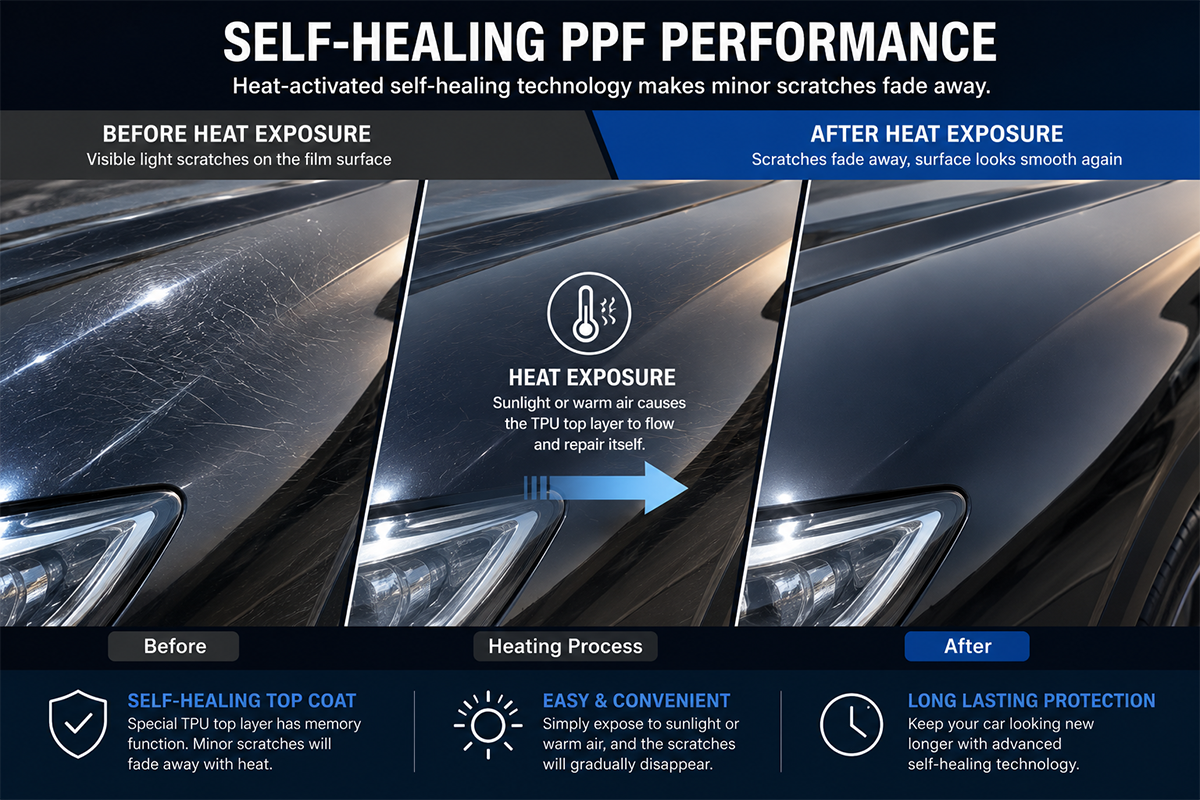
Self-healing does not mean that a damaged film can completely restore itself after every type of accident. Instead, certain films use a specially engineered top layer that can respond to heat. When exposed to suitable warmth, the material can gradually reduce the visibility of some fine surface scratches.
This process is commonly known as heat repaired or heat-activated self-healing.
For example, a light mark created during routine cleaning may become less noticeable after exposure to sunlight or an appropriate controlled heat source. The result depends on the film's construction, temperature, and depth of the scratch.
If a scratch cuts deeply through the protective layer, however, heat repair should not be expected to restore the film completely.
Does Self-Healing Make PPF Maintenance-Free?
No. This is an important distinction for vehicle owners.
Self-healing can help maintain the appearance of the film, but it does not remove the need for proper washing and maintenance. Dirt, bird droppings, insects, tree sap, and road contaminants should still be removed regularly.
Using unsuitable chemicals, abrasive materials, or aggressive cleaning techniques can create unnecessary wear. Following the film manufacturer's care recommendations is therefore a better approach than assuming the surface can repair any damage by itself.
In practical terms, self-healing is best viewed as an additional maintenance advantage rather than a replacement for maintenance.
Why Should You Pay Attention to Yellowing?
For a transparent protective film, appearance is just as important as physical protection. If a clear film becomes noticeably yellow or loses clarity, it can change how the original paint looks.This is why anti-yellowing performance is an important consideration when comparing PPF products.
Long-term exposure to UV radiation, environmental pollution, chemicals, bird droppings, tree sap, and other contaminants can gradually affect exterior materials. A well-formulated film should help resist discoloration and effectively delay the yellowing process under normal conditions.
Buyers should still avoid claims such as “never yellows.” Real-world performance depends on material quality, climate, exposure, installation, and maintenance.
What Should Buyers Look for in PPF?
A good purchasing decision should involve more than comparing prices. Product specifications, material construction, optical clarity, thickness, flexibility, adhesive performance, anti-yellowing properties, and self-healing behavior can all affect the final result.
Installation is another critical factor. Even a technically advanced film can look poor if the vehicle is not properly prepared or the film is incorrectly positioned.
It is also useful to consider the actual driving environment. A highway driver who frequently encounters loose gravel may prioritize front-end protection, while an urban driver may be more concerned about door edges, mirrors, and parking-related contact.
For installers and vehicle owners looking for a practical solution, Motec Paint Protection Film is one option developed for everyday automotive paint protection, combining a clear protective layer with features intended to support surface durability and long-term appearance.
A More Practical Way to Think About PPF
The value of PPF is not that it makes a vehicle impossible to damage. Its value is that it changes where everyday wear occurs.
Instead of allowing every light scratch, road particle, or minor contact to affect the original paint, the protective film provides an additional surface designed to take that exposure. When combined with heat-activated self-healing and good anti-yellowing performance, modern PPF can offer both physical protection and long-term visual benefits.
For vehicle owners who care about maintaining an original factory finish, choosing a suitable film and having it professionally installed can be a practical way to reduce everyday paint wear.
The most reliable approach is to understand the product's actual capabilities, follow proper maintenance practices, and choose protection based on how the vehicle is genuinely used.