

A vehicle’s paint is exposed to more than just obvious road hazards. Even without an accident or major impact, daily driving can gradually leave marks on the exterior. Highway travel can bring small stones and road debris, while city driving creates different risks around parking spaces, narrow streets, and heavy traffic.
For drivers who want to keep their vehicle’s original finish in good condition, paint protection film (PPF) offers a way to reduce this everyday wear. But whether it is worthwhile depends on how the car is used, which areas are most exposed, and what the owner expects from the film.
Rather than treating PPF as a guarantee against every type of damage, it is more useful to view it as an additional protective layer designed for specific real-world conditions.
What Kind of Damage Does Daily Driving Cause?
Different driving environments create different types of paint damage.
A car that spends most of its time on highways may encounter loose gravel, sand, and small road particles at relatively high speeds. These impacts are especially relevant to the front bumper, hood, fenders, and mirrors.
Urban vehicles face another set of problems. Tight parking spaces, shopping carts, bags, door contact, and branches can create light scuffs and surface scratches. Even frequent washing can contribute to fine marks when unsuitable tools or techniques are used.
This is why there is no single “most important” area to protect. The right PPF coverage should reflect how the vehicle is actually driven.
Where Can PPF Make the Biggest Difference?
For many vehicles, the front end is the first area worth considering. The bumper and leading section of the hood receive direct exposure to road particles, while the front fenders and mirrors can also encounter debris.
Other areas may deserve attention depending on the owner's routine. Door edges can be vulnerable in crowded parking areas, and rocker panels may collect dirt and particles from the road.
A full-vehicle installation is not the only option. Targeted coverage can provide protection to high-risk areas while allowing owners to manage installation costs according to their priorities.
This practical approach can be especially useful for daily drivers that are more concerned about preventing visible wear than achieving maximum coverage.
Can PPF Reduce the Appearance of Scratches?
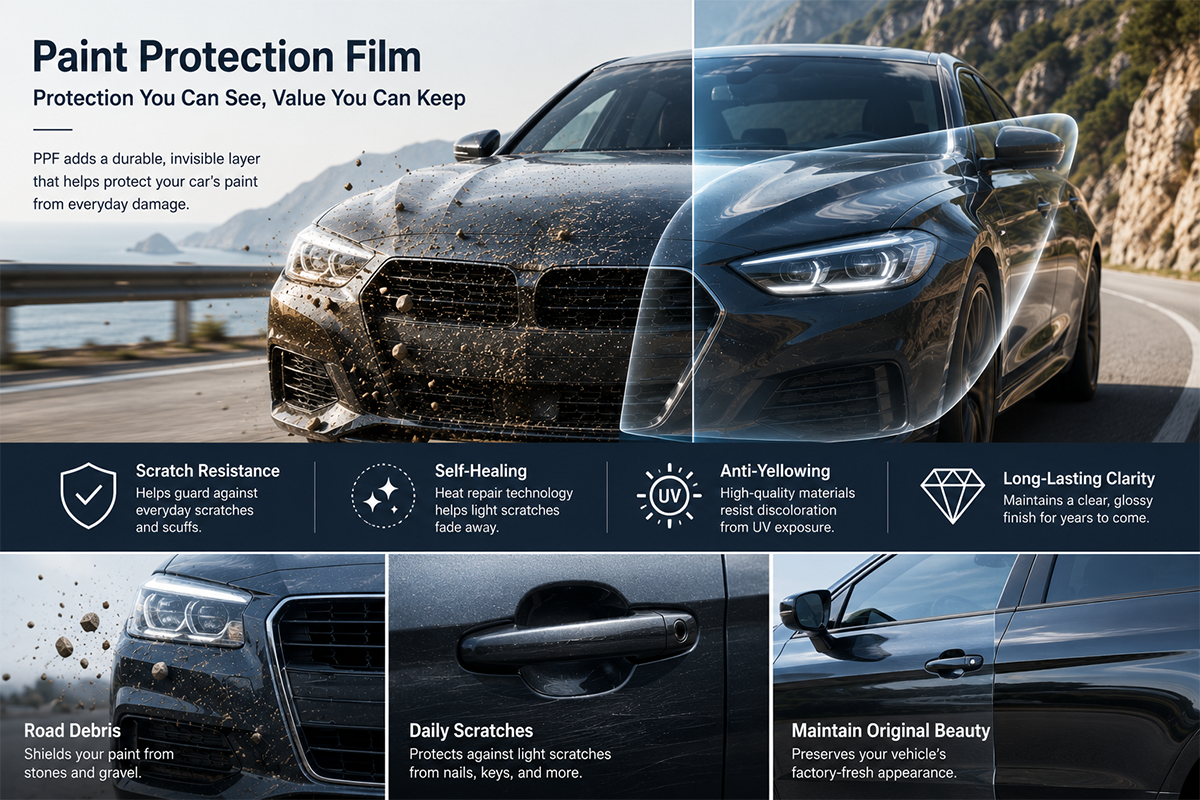
One of the key benefits of PPF is its ability to provide a sacrificial surface over the original paint. A suitable film can help resist many light scratches and scuffs that occur during ordinary use.
This does not mean that PPF is completely scratch-proof. A sharp object or severe impact can still cut through the film. The purpose is to reduce the likelihood that common minor contact will directly damage the factory paint.
For vehicle owners, this distinction matters. The value of a protective film is not that it eliminates every possible risk, but that it can take much of the routine surface wear that would otherwise affect the paint.
What Role Does Self-Healing Play?
Some modern films use a top layer with self-healing characteristics. When the surface develops certain fine scratches, heat can help the material return toward a smoother condition.
This is often referred to as heat repair or heat-activated self-healing. Sunlight may provide enough warmth for some minor marks to become less noticeable, although results vary according to temperature, film construction, and scratch depth.
The technology is most relevant to light surface damage. Deep cuts or damage that penetrates the film should not be expected to disappear simply through heating.
From a maintenance perspective, this feature can be useful because minor surface marks are a normal part of owning and washing a vehicle.
Why Does Film Clarity Matter Over Time?
Physical protection is only one part of a good PPF. Since the film is normally transparent, its appearance after months or years of use is also important.
This is where anti-yellowing performance becomes relevant. Ultraviolet exposure, environmental pollution, chemicals, bird droppings, and tree sap can all affect exterior materials over time.
A well-formulated PPF should help resist discoloration and delay the yellowing process, allowing the original paint to remain visually clear through the protective layer. However, long-term results are influenced by product quality, climate, installation, exposure, and maintenance.
For this reason, buyers should be cautious about absolute claims such as “never yellows” and instead evaluate documented product characteristics and realistic service conditions.
Is PPF Suitable for Every Driver?
Not necessarily. A vehicle that is rarely driven, stored indoors, and carefully maintained may have less exposure to everyday hazards than a commuter vehicle traveling long distances every week.
Driving habits should therefore be part of the purchasing decision. Someone who frequently drives on highways may prioritize front-end protection, while a city driver may find greater value in protecting mirrors, door edges, and other high-contact areas.
Budget is another consideration. PPF is an investment in preserving the existing finish, so the expected benefit should be compared with the vehicle’s usage and the owner’s priorities.
Choosing a Reliable PPF
Product specifications should be considered alongside installation quality. Important characteristics include optical clarity, flexibility, scratch resistance, adhesive performance, self-healing behavior, durability, and anti-yellowing capability.
The installer also plays an important role. Proper paint preparation, accurate pattern placement, careful handling of edges, and a clean working environment can all influence the finished appearance.
For vehicle owners and professional installers looking for an automotive protection option, Motec Paint Protection Film is designed around everyday paint protection, with attention to surface durability, clarity, self-healing performance, and long-term appearance.
Final Thoughts
The value of paint protection film is closely connected to real-world driving conditions. It can help reduce everyday surface damage, provide a sacrificial layer against light scratches, and, with suitable technology, make minor marks less noticeable through heat-activated repair.
At the same time, good **anti-yellowing performance** helps preserve the visual clarity of a transparent film over time.
PPF should not be viewed as an unlimited shield. Its real advantage is more practical: it gives the vehicle’s original paint an additional layer of protection where everyday driving creates the greatest risk.
For owners who want to preserve their factory finish, choosing the right coverage, a suitable film, and a qualified installer can make PPF a worthwhile part of long-term vehicle care.