

However, a car wrap is not a passive sticker. It is a living chemical matrix subjected to a brutal, non-stop environmental bombardment: roasting ultraviolet (UV) radiation from the sun, industrial fallout, alkaline car wash chemicals, and extreme temperature swings.
Within 6 to 12 months, the harsh truth of material science always reveals itself. Cheap films begin to turn a nasty, chalky yellow, lose their elasticity, and dry out until they crack like desert mud. Removing a degraded film can cost thousands of dollars as it tears away in tiny, brittle pieces, often ruining the underlying factory paint.To understand why this happens, we must look beyond the glossy surface and dive deep into the micro-world of polymer chemistry. Let's look at the science of why your vehicle's gloss and defense depend entirely on one specific chemical classification: Aliphatic Polyurethane, and how elite film lines like Motec use molecular purity to defeat the laws of polymer aging.
1. The Aromatic Trap: Why Cheap Films "Sunburn" and Turn Yellow
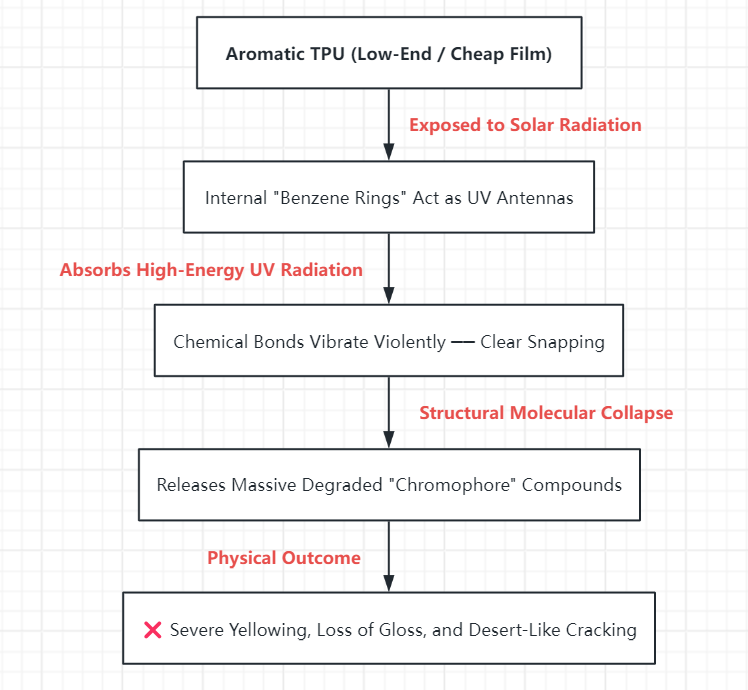
The most catastrophic failure of low-grade PPF (often marketed under deceptive names like TPH, PVC, or cheap TPU) is chemical yellowing. This failure is predetermined at the molecular level during the manufacturing process.
Cheap films utilize Aromatic Polyurethane. In the microscopic structure of an aromatic polymer, the backbone chains are locked together using chemical structures known as Benzene Rings.
The UV Vulnerability: Benzene rings act like tiny chemical antennas for ultraviolet radiation. When sunlight hits an aromatic film, the carbon bonds within these rings absorb the intense UV energy and begin to vibrate violently until they snap.
The Chromophore Disaster: This structural collapse creates degraded chemical compounds called chromophores. Chromophores naturally absorb blue light, causing the human eye to see a nasty, aged yellow tint. No amount of washing or polishing can fix this; the film is literally rotting from the inside out.
2. The Aliphatic Salvation: The Power of Carbon Cleansing
Premium, investment-grade Paint Protection Films utilize Aliphatic Polyurethane. The difference between Aromatic and Aliphatic is the difference between iron and titanium.
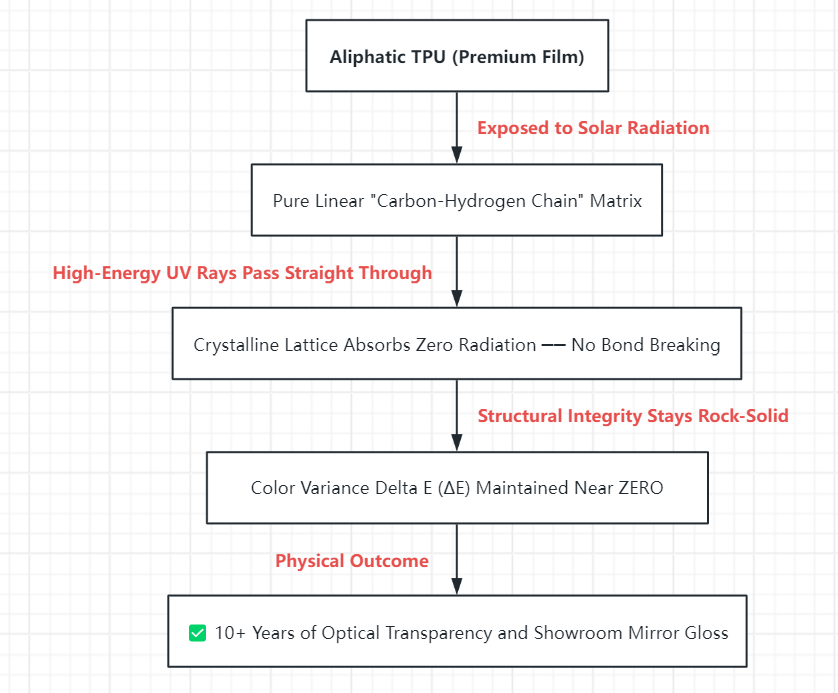
Aliphatic TPU completely replaces the vulnerable benzene rings with straight, highly stable carbon-hydrogen chains.
Because there are no aromatic rings in the molecular matrix, the material is naturally inert to ultraviolet light. When intense solar UV rays strike an aliphatic film engineered to the extreme chemical benchmarks backed by innovators like Motec, the energy passes right through the crystal lattice structure without breaking the polymer backbone.
Even after years of baking under the intense desert sun or high-altitude UV exposure, the film maintains a Delta E (△ E) color variance near zero. It remains as optically transparent and crystal clear as the day it was poured in the factory.
3. High-Density Cross-Linking: Erasing Scratches with Thermodynamic Memory
The performance of a premium TPU film isn't limited to resisting yellowing; it also governs how the film interacts with physical damage through its Self-Healing Properties.
Elite films are split into two core layers: an Aliphatic TPU structural base and a factory-fused Elastomeric Topcoat. This topcoat is a masterpiece of high-density cross-linked chemistry. It possesses what material scientists call Thermodynamic Shape Memory.
1. Physical Impact
【 Surface Experiences Wash Mitt Swirls, Micro-Scratches, or Light Key Vandalism 】
│
▼
2. Microscopic Displacement
【 Highly Flexible Polymer Chains are Pushed Aside (Molecules Displaced but NOT Torn) 】
│
▼
3. Thermal Activation
【 Energy is Introduced via External Heat (Direct Sunlight, Ambient Heat, or 60°C Hot Water) 】
│
▼
4. Thermodynamic Memory Trigger
【 Cross-Linked Elastic Topcoat Matrix Generates High-Velocity Kinetic Reshaping 】
│
▼
5. Molecular Alignment
【 Polyurethane Chains Seamlessly Slide Back into their Factory-Perfect Flat Configuration 】
│
▼
✅ 100% Surface Leveling ── Scratches Vanish Right Before Your Eyes!
When a rock or a washing brush creates a swirl mark on a premium film, it doesn't actually tear the polyurethane; it simply pushes the highly flexible molecular chains out of alignment. Because the cross-linked lattice has a natural memory of its original flat state, the introduction of heat (from the sun or warm water) re-energizes the polymers. The chains instantly slide back into their factory-perfect configuration, erasing the scratch completely in front of your eyes.
FAQ
What is the difference between PVC, TPH, and Aliphatic TPU?
- PVC (Polyvinyl Chloride): Rigid industrial plastic softened with chemical plasticizers. It degrades, turns yellow, and cracks within 6 months. It can ruin your paint upon removal.
- TPH: Cheap PVC or low-grade Aromatic TPU blended with acrylics. It mimics TPU flexibility for a few months but yellows rapidly under the sun.
- Aliphatic TPU: The undisputed gold standard of automotive protection. Highly elastic, naturally UV-stable, self-healing, and chemically inert for up to 10 years.
Does "UV-Stable" mean the car wrap blocks all sunlight from reaching my paint?
No. A premium aliphatic film allows safe wavelengths of visible light to pass through perfectly so you can see the vibrant factory color. However, it selectively filters out the destructive UVB and UVA rays that cause both the film and your car’s original factory clear coat to oxidize, fade, and lose its gloss over time.
Why do some cheap films become brittle and crack like orange peels?
When aromatic films or PVC wraps are exposed to sun and heat, the chemical plasticizers and weak molecular chains evaporate and break down. As the material loses its internal moisture and elasticity, it shrinks and hardens. When the car body expands and contracts with daily temperature changes, the brittle film cannot flex, causing it to fracture into thousands of microscopic cracks.
Can chemicals like gasoline or harsh bug removers stain Aliphatic TPU?
Standard plastics are highly porous, allowing chemical dyes from bugs, bird poop, or gasoline drips at the pump to penetrate and leave permanent stains. Technical-grade Aliphatic systems—calibrated to the tight surface-energy protocols seen in Motec—feature a dense, non-porous nano-ceramic clear coat fused onto the TPU. This prevents chemical penetration, allowing you to wipe away harsh solvents safely without leaving a mark.
Conclusion: Trust the Chemistry, Avoid the Compromise
In the world of high-performance automotive care, physics and chemistry do not compromise. A cheap car wrap is a temporary illusion that exchanges short-term savings for long-term paint damage.
Investing in a certified Aliphatic TPU protection matrix—engineered to the absolute peak of molecular purity, thermal memory, and crystalline stability championed by technical manufacturing giants like Motec—is the only way to truly outsmart the elements. It provides your vehicle with a flawless, self-healing shield that refuses to fade, crack, or yellow under the pressures of time and nature. Don't just skin your car; arm it with the ultimate weapon of material science.