

When you are cruising down the highway at 70 mph, the environment around your vehicle is far more violent than it appears. Every car in front of you acts as a potential catapult, launching microscopic grit, road salt, and jagged gravel directly at your leading edge. For many car enthusiasts, the solution is Paint Protection Film (PPF). However, a persistent skepticism remains: How can a film only 8.5 mil thick (about the thickness of two human hairs) possibly stop a stone from chipping the paint?
Understanding the value of PPF requires moving past the idea of "thickness" and looking into the sophisticated physics of energy dissipation. To make an informed investment, owners must understand why 8.5 mil is the industry's "sweet spot" and how it functions under duress.
The Anatomy of an Impact: Why Paint Chips
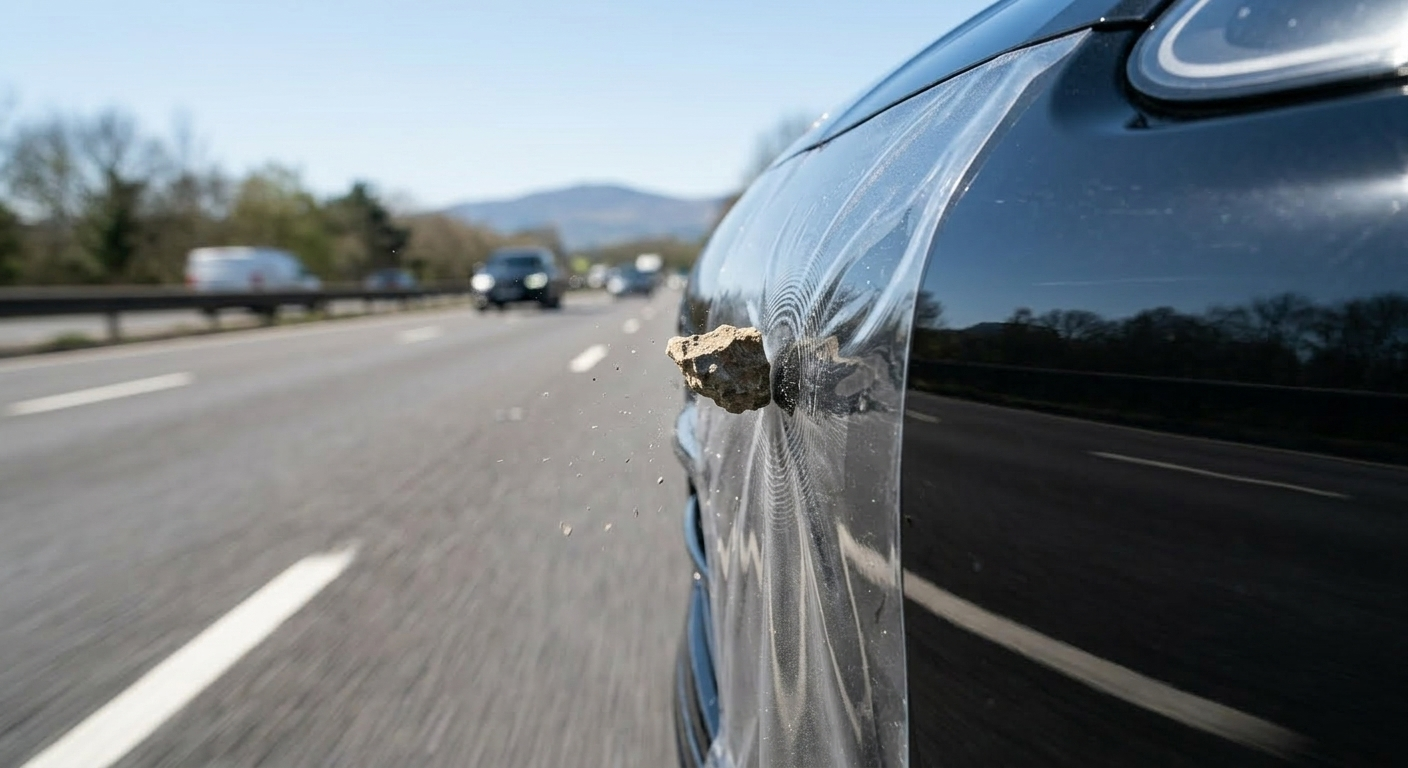
To understand why PPF works, we must first understand why car paint fails. Modern automotive paint is designed for aesthetics and environmental compliance, not impact resistance. It is thin, brittle, and bonded to a hard metal or plastic substrate. When a stone hits an unprotected hood, the energy is concentrated on a microscopic point. Because the paint cannot deform, it shatters. This creates the "star" or "chip" that exposes the primer or bare metal beneath.
Physics tells us that Force equals Mass times Acceleration (F=ma). At highway speeds, even a tiny pebble carries significant kinetic energy. Without a buffer, the paint absorbs 100% of that energy instantaneously.
The 8.5 Mil Logic: More Than Just a Barrier
The standard thickness for high-performance PPF, such as the series offered by Motec, is 8.5 mil. While it might seem thin, its efficacy lies in its Thermoplastic Polyurethane (TPU) composition. Unlike a hard shell, TPU is a viscoelastic material.
When a stone strikes an 8.5mil TPU film, the following physical process occurs:
1. Compression: The film compresses under the point of impact. This small amount of "give" increases the time it takes for the stone to come to a stop. In physics, increasing the impact time reduces the total force applied to the surface.
2. Energy Diffusion: Instead of the energy traveling straight through to the paint, the TPU molecules spread the force laterally across the film’s surface.
3. Elastic Rebound: Once the energy is dissipated, the TPU's "shape memory" allows it to return to its original flat state.
This is the "bulletproof vest" logic. A vest doesn't stop a bullet by being harder than the bullet; it stops it by catching it and spreading the energy across a wider surface area.
Why Not Go Thicker?
A common "People Also Ask" question is: "If 8.5 mil is good, is 12 or 15 mil better?" Not necessarily. In the world of PPF, there is a law of diminishing returns.
If a film is too thick, it becomes excessively rigid. Rigid films are difficult to install around complex curves, leading to unsightly "fingers" or edges that lift over time. Furthermore, excessively thick films can actually reduce optical clarity, giving the car a dull, "wrapped" look rather than a factory-fresh finish. The 8-mil standard represents the perfect balance between maximum impact protection and the flexibility required for a seamless, invisible installation.
Beyond Rocks: The Battle Against "Daily Dings"
While "rock chips" are the headline fear, PPF deals with more frequent, lower-velocity threats in daily life. Imagine a shopping cart grazing your fender or a neighbor’s car door tapping yours in a tight parking lot.
In these scenarios, the 8.5mil TPU layer acts as a sacrificial barrier. Most of these "impacts" only affect the top coat of the film. Because premium films feature a heat-activated top layer, the friction from the cart or door may leave a mark, but a few hours in the sun or a splash of warm water allows the film to "heal" itself. The paint underneath remains untouched, preserved in its original state.
The Role of Adhesive in Impact Resistance
An often-overlooked component of the "impact logic" is the adhesive layer. For a film to dissipate energy effectively, it must remain perfectly bonded to the paint. If there is a gap or a "dry spot" in the adhesive, the film will tear upon impact rather than stretch.
High-quality professional films utilize advanced acrylic adhesives that create a uniform bond. This bond ensures that the TPU layer can move and stretch as a single unit with the car's body panels. This structural integrity is what prevents the film from "pitting" or developing holes after a long road trip through construction zones.
Precision Matters: The Edge of Protection
A rock doesn't care where your film ends. One of the most common points of failure in paint protection is the "exposed edge." If a film is cut poorly and leaves a 2mm gap at the edge of the hood, that is exactly where a stone will land.
This is why digital pattern precision is vital. By using software to design patterns that allow for "wrapped edges," the protection extends around the corner of the panel. This eliminates the vulnerability of the leading edge and ensures that the physical protection logic is applied to every square inch of the vehicle's strike zones.
Long-Term Value and Peace of Mind
Investing in an 8.5mil barrier is ultimately about preserving the vehicle’s "Skin." Every chip in the paint is a permanent scar that reduces the car's resale value and increases the risk of oxidation or rust. While no film is "invincible" against a massive brick at high speed, the 8.5mil TPU standard handles 99% of what the road throws at you.
When choosing your protection, look for a brand that prioritizes TPU quality and pattern accuracy over mere marketing claims. While Motec provides these high-standard solutions, the logic remains universal: protection is about managing energy.
By installing a high-quality 8.5mil PPF, you aren't just putting a sticker on your car. You are installing a high-tech shock absorber that stands between your prized possession and the harsh reality of the open road. Drive with confidence, knowing that physics is on your side.